I think I have found my parenting style!
My first ever blog which was highly commended in The Green Parent writing competition 2016.
I spent a lot of time over the summer reading articles about Jean Liedoff’s book , The Continuum Concept. I first heard of the book before I was a parent and then read it once I had children hoping it would give me all the answers to my parenting questions! I have long since realised that no such book exists (for me anyway), how can you have a one-size fits all parenting manual when every family and every child are unique? At the time of reading this book it didn’t make the impact I was hoping for (I really did want an instruction manual!) but recently I have realised that a lot of my interest in attachment parenting and the reading I have done around this parenting style, have their origins in Liedoff’s work.
My holiday reading has led me to the following conclusions:
1. Children deserve respect; they are just small human-beings like you and me. It’s not that I didn’t think this before, I just think I had a tendency, at times, to treat a child in a way I would never treat an adult. By this I mean, I might laugh at a child’s comment that I found humorous which inadvertently offended the child who was very serious about what they were saying. I would speak to children in a different way than I did to adults e.g. shout “DOOR!” when they had forgotten to shut the door for the umpteenth time. Whereas, if speaking to an adult I would have said “Is it alright if you shut the door please?”. My thinking on respectful parenting has also been influenced by Lucy Aitken Read who blogs at www.lulastic.co.uk
2. Children want to be like adults. They want to please parents and teachers. I have always known this, even way before parenting when I was in the early stages of my teaching career I could see that children wanted to please (unless they had been disillusioned due to the style of education that had been imposed on them or due to a difficult home life). However, even with this knowledge I still sometimes treated my children like they were against me, like life was a battle between them and me.
3. Our present state school system and many of the mainstream parenting ideas in the UK (and many other western countries) are relatively new. If you think in terms of human evolution for most of the time we have lived in small mixed-aged communities where children have learnt by watching adults and older children, with children joining in when ready developmentally. This includes all skills needed for life including learning skills usually taught in school such as reading. If the community was literate, children would see other people reading and would want to read too ( www.schoolingtheworld.org/a-thousand-rivers).
This has led me to finally (I hope) find a parenting style that sits well in my heart and to adopt the following principles:
1. No sanctions or rewards. This is how most adults live their lives. I don’t only get to buy a treat or go to a nice place if someone else has said my behaviour is good enough! This would mean I was in a very controlling and unhappy relationship and not the sort of equality I would expect. So, when my children behave in an unacceptable way, I ask them to stop. That’s it! It may not work immediately and they may need reminding again. There was a bit of a transition stage when I felt some behaviours escalated slightly as the children were unfamiliar with this no consequence approach. However, now I ask them to stop, I expect them to stop. We may talk about it and then we move on with our day.
In terms of rewards, I want my children to be intrinsically motivated and to do what is right because they know it’s right. If I go back to the idea that children want to be like adults then when parent’s role-model the behaviour they want from their children in their interactions and relationships, children will want to behave like the adults. This then, in turn, has the advantage of parents forming good relationships with other people. Yes, I can admit this can be difficult. Relationships can be hard and when stressed and tired it can feel like children are pushing our buttons. I have found myself shouting “STOP SHOUTING!!” I am hoping this is now mostly in my parenting past, I am striving to behave in the
way I would like my children to behave.
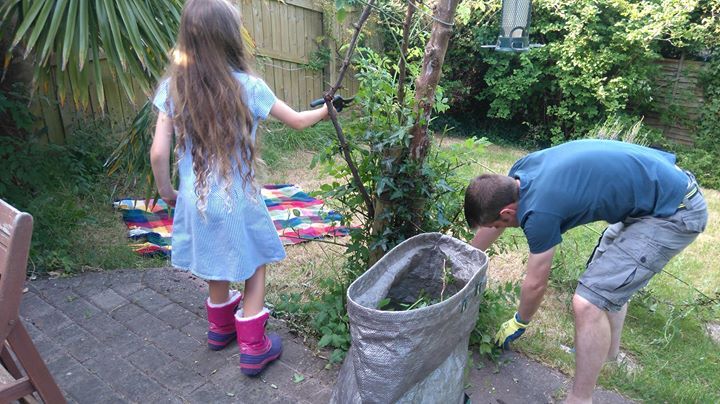
2. Be less child-centred. What?! Less child-centred? How can that be a good thing? I am a trained primary school teacher, have worked as a childminder and in a Children’s Centre and have always felt child-centredness to be very (in fact the most) important consideration. I still think this is the best way for children to learn and an essential part of school and home life. However, if I think about how historically we have lived in small communities where children have learnt from adults and older children. If we are too child-centred we can take away the possibility of children mimicking ‘adult work’. How can children learn from and aspire to be part of the adult world if they have no adult world to observe? By this, I mean adults doing what adults want or need to do in its varying forms: hanging out the washing, preparing a meal, following their own interests and hobbies etc. It is good for children to see this and learn from it and it is certainly good for parents. A quote that has stuck with me for some time is “The greatest tragedy of the family is the unlived lives of the parents” (Carl Jung). I have certainly been that parent who has put my children’s needs above my own (as so many parents do) as if my needs were not important. I have the feeling of losing my identity somewhere along the parenting road. I would support and follow my children’s interests but not my own, often leaving me with a dissatisfied and, at times, a resentful feeling. How refreshing to feel that meeting my needs, is not only important to me, but essential for my children’s learning and development. Right now as I write this, my daughter is entering a competition. We are sat at the same table, I stop to help her when she asks me to but I am able to continue with my own interests which is good for my well-being but also provides a role-model for my daughter showing her that adults like writing, that perseverance is important and that having a go and maybe not winning is okay too!
3. Say what I mean and expect my children to listen. I have realised I often used to tell my children things they already knew. For example, in my house on a school day we always have breakfast first and then get dressed. My children are now 8 and 6 years old. They know what needs doing on a school morning. So why have I been constantly reminding them? By doing this, I thought I was being helpful but now I feel that I was making it sound like I didn’t trust them. Now I generally say nothing (or only remind them when necessary) and mornings (which so often are a major flash point in the day for parents who have children at school) are so much better (not always perfect, of course!). When it’s time to
leave the park I give them a 5 minute warning, then we go. I no longer count down “4 minutes, 3 minutes, 2 minutes, 1 minute, time to go, lets go now etc” as if I didn’t believe they would leave (because I didn’t believe they would leave!). This is not a total fail-proof approach but in the main I find it successful.
So this is my evolving parenting journey. It’s not the right journey, it’s just my journey. It’s been up and down and I’m sure there are some bumpy roads left but I seem to have found a way that feels right in my heart and that sureness and confidence seems to be paying off.
Further Reading: